An open house is a few hours on a Sunday, but it starts a week earlier and ends two days later. Agents who get the most out of one usually aren’t doing anything fancy. They invite the right people, make the house easy to understand, and follow up quickly.
This guide is for agents hosting a listing open house. It has 35 open house ideas split into before, during and after, a printable open house checklist, the two ways to handle sign-in, and follow-up texts and emails you can copy.
Quick answer: what makes a good open house
- Before: enter it in the MLS, post it twice, invite the neighbors, and give the listing one link with all the photos and the open house time.
- During: greet everyone at the door, ask them to sign in and whether they’re working with an agent, and let the house speak with labels and a floor plan.
- After: update the sellers the same day and follow up with every visitor within 24 hours, mentioning something they liked.
35 open house ideas for real estate agents
Before the open house
Most of an open house happens before the door opens. The week before decides who shows up.
- 1. Pick a time that doesn’t compete. Weekend afternoons (for example 1–4 pm) are the norm. Check the local calendar for big games and events, and look in the MLS for other open houses nearby at the same price.
- 2. Enter it in the MLS open house fields. Many MLSs pass open house times to the big portals, so buyers searching there see it too. Check the date and time once it shows up.
- 3. Give the listing one link to share. A property page with all the photos, the price, the details and the open house time. The same link goes in your posts, texts, emails and on the QR code of your feature sheet.
- 4. Invite the neighbors first. Knock on a few doors or leave a note a week before, and offer a neighbors’ preview 30 minutes before the public opens. Neighbors often know someone who wants to move close by.
- 5. Post it twice. Three days before and the morning of, with the date, time, address and one reason to come. A short walkthrough Reel works better than a flyer graphic.
- 6. Text the buyers who fit. Send it to people in your contacts looking in that area and price range. One line and the link, no attachment.
- 7. Tell the agents who work the area. A short email to local agents, or a broker open on a weekday, brings their buyers through.
- 8. Plan the directional signs. Check HOA and city rules first. Put signs at the turns from the nearest main road on the morning of, and pick them up the same day.
- 9. Print a one-page feature sheet. The best photo, beds, baths, square feet, price, the updates with their years, and a QR code to the property page.
- 10. Walk the house with the sellers. Ask them to put away valuables, prescriptions, mail and keys, and to be out during the open house. Agree on which rooms and closets are open.
- 11. Set up the sign-in. A paper sheet on the counter, a QR code visitors can scan, or both. More on this below.
- 12. Prepare answers to the usual questions. Roof and HVAC age, utility costs, HOA fees, property taxes, what stays with the house and when the sellers want offers.
One link for the whole campaign: instead of attaching photos to every text, share a property listing link with the photos, price, details and a contact button. For the posts themselves, see our real estate social media post ideas, and write the feature sheet copy with the free listing description generator.
During the open house
Your job in the room is to be easy to talk to and to learn who each visitor is.
- 13. Arrive 45 minutes early. Lights on in every room, blinds open, a comfortable temperature, quiet music, and the trash taken out.
- 14. Greet everyone at the door. Introduce yourself, hand them the feature sheet and ask them to sign in. People say yes when asked in person.
- 15. Ask “Are you working with an agent?” early. It tells you who to follow up with, and keeps you from soliciting another agent’s client.
- 16. Let people look on their own. Don’t lead a tour. Tell them what not to miss (“the backyard is bigger than it looks”) and stay where they come back to, usually the kitchen.
- 17. Label the things you’d have to explain. Small cards: “Roof replaced 2022”, “Windows 2023”, “Washer and dryer stay”. They answer questions when you’re busy with another group.
- 18. Put a printed floor plan on the counter. It helps people remember the house, and it gives you something to talk about.
- 19. Keep refreshments simple. Bottled water and wrapped snacks. Skip strong smells and anything that can stain.
- 20. Have the documents ready. The disclosures your state requires, the HOA summary, and a list of recent updates. Ask the sellers what you can share.
- 21. Offer a neighborhood sheet. Parks, commute times, shops and links to official sources (the school district’s own site, the city’s pages). Describe places, not the people who live there.
- 22. Take a note after each conversation. What they liked, what they didn’t, and what they asked. Your follow-up depends on it.
- 23. Use a tablet at the door when it’s busy. A phone or tablet with the sign-in form open lets a group sign in while you talk to the last one.
- 24. Try a weekday evening. A “twilight” open house from 5 to 7 pm reaches people who can’t come on a weekend, and it shows the house with lights on.
- 25. Stay safe. Tell someone where you are and when you’ll finish, keep your phone charged and with you, walk behind visitors rather than ahead, and know your way out of every room.
- 26. Ask one easy question at the end. “What did you think of the kitchen?” or “Is this the size you’re looking for?” is enough to start a follow-up.
After the open house
The open house isn’t over when you lock the door. Most of what it’s worth comes in the next 48 hours.
- 27. Lock up with a checklist. Every door and window, lights off, the thermostat back to where the sellers had it, and a walk through every room.
- 28. Send your follow-ups within 24 hours. While they still remember the house. Examples below.
- 29. Report to the sellers the same day. How many groups came, what they said about the price and the house, and what you’d change.
- 30. Fix what visitors kept mentioning. A dark room, a smell, a confusing photo order. Small fixes before the next showing.
- 31. Send the listing link to anyone who asked. Photos, price and details on one page they can forward to a partner or parent.
- 32. Thank the neighbors who came. A short note, and ask if they know anyone who would like to live nearby.
- 33. Save every visitor with a note. Name, contact, the property and what they told you, tagged with the open house date.
- 34. Count what worked. How many signed in, how they heard about it (signs, portal, social, neighbors) and how many replied to your follow-up.
- 35. Plan the next one. If the first was busy, a second open house the next weekend often brings the people who missed it.
Simple ideas for a small open house
A condo or a starter home doesn’t need catering, a food truck or raffles. If you only have time for a few things, do these, in this order:
- Put it in the MLS and post it twice.
- Invite the neighbors with a note under the door.
- Label the updates and print the floor plan.
- Ask every visitor to sign in, on paper or with a QR code.
- Follow up with everyone within 24 hours.
That costs a few printed pages and an hour of your time, and it covers what visitors remember: an easy house to understand and an agent who got back to them.
Open house sign-in: paper sheet or QR code
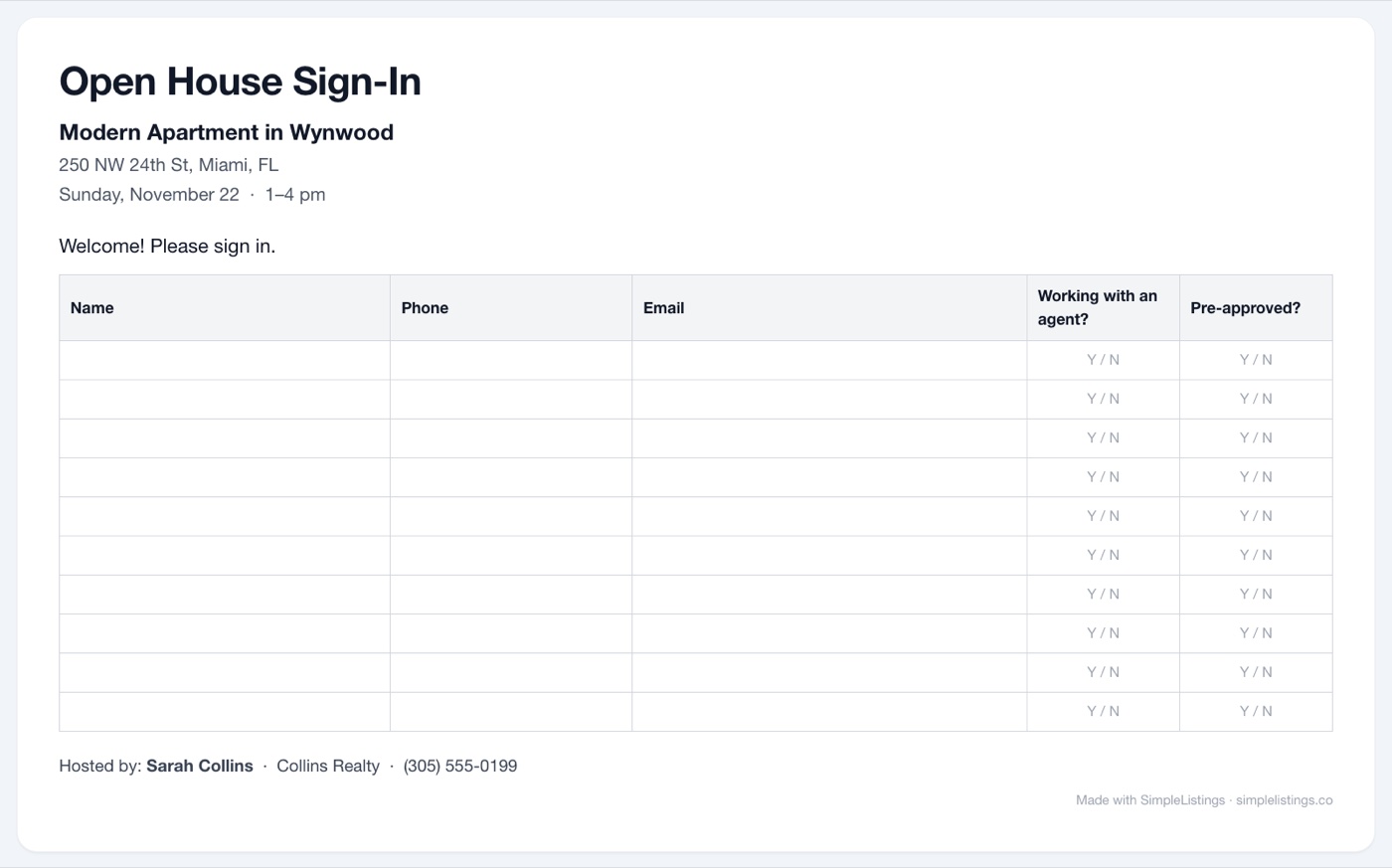
The sign-in is where your follow-up starts, so it’s worth five minutes of thought. Keep it short: name, phone, email and two yes/no questions, “Working with an agent?” and “Pre-approved?”. Every extra field means fewer people fill it in.
| Paper sign-in sheet | QR code, sign in on the phone | |
|---|---|---|
| At the door | Familiar, nothing to explain | Scan, type, done; several people at once |
| Names and numbers | Handwriting, missing digits | Typed by the visitor |
| Privacy | Everyone sees the names above theirs | Each visitor sees only their own |
| After the event | Type the list up yourself | Already saved, ready to follow up |
Most agents use both: a clipboard for people who prefer paper and a QR code next to it. Our free open house sign-in sheet lets you add your details and the property, choose the “Working with an agent?” and “Pre-approved?” columns, and print it or save it as a PDF. No signup and no watermark.
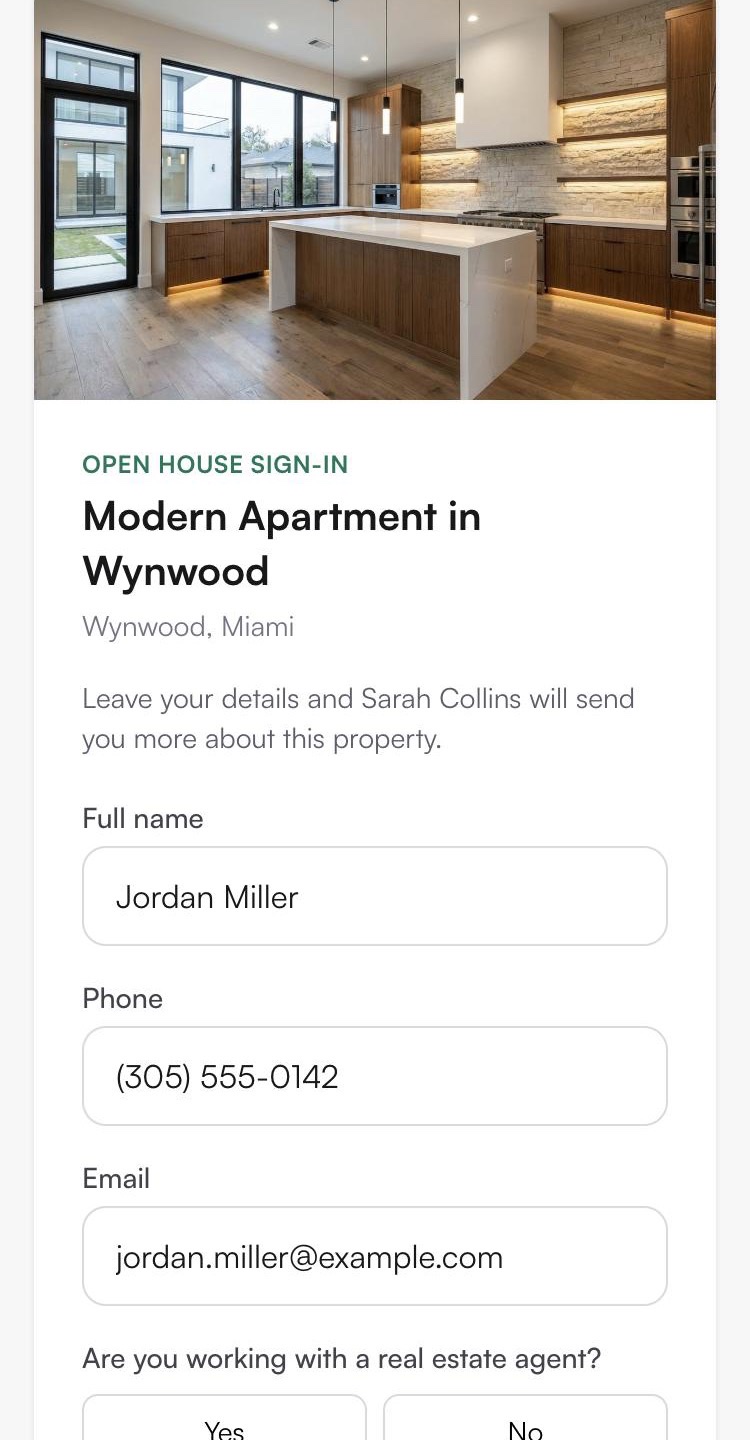
With a free SimpleListings account, each property gets its own sheet with a QR code. Visitors scan it and sign in on their phone with their name, a phone number or email, and the two questions. Each sign-in is saved on that property, marked “Open house”, and you get an email. After signing in, visitors can open the listing page to see the photos again. On a tablet at the door, one tap clears the form for the next visitor.
Print your open house sign-in sheet Your details, the property and the visitor columns, ready to print or save as a PDF. Add a QR code so visitors can sign in on their phone.
Make my sign-in sheetOpen house checklist
Print this page or copy the list into your notes. It follows the order you’ll need it in.
One week before
- Open house date and time agreed with the sellers
- Open house entered in the MLS
- Property page updated with the date and time
- Social posts scheduled (three days before and the morning of)
- Neighbors invited
- Sign rules checked (HOA, city)
- Feature sheet, floor plan and neighborhood sheet sent to print
The day before
- Sellers know what to put away and when to leave
- Sign-in ready: printed sheet, QR code, or both
- Phone and tablet charged
- Questions answered: roof, HVAC, utilities, HOA, taxes, what stays
- Disclosures and documents you’re allowed to share
- Someone knows where you’ll be and until when
One hour before
- Directional signs out
- Lights on, blinds open, temperature set
- Trash out, counters clear, pets and their bowls gone
- Water, snacks, feature sheets and pens on the counter
- Feature labels in place
During
- Greet every visitor at the door
- Ask everyone to sign in
- Ask “Working with an agent?”
- A note after each conversation
After
- Doors and windows locked, lights off, thermostat reset
- Signs picked up
- Sellers updated the same day
- Follow-ups sent within 24 hours
- Visitors saved with notes
Open house follow-up texts and emails
A good follow-up is short, mentions something specific about the house, includes the listing link and asks one easy question. Send it within 24 hours. Replace the [brackets] with your own details.
Text, the same day
For visitors without an agent who gave you a phone number.
Hi [name], it’s [your name] from the open house at [address] today. Thanks for coming by! You mentioned [the backyard], so here are all the photos and details: [listing link]. Would you like me to send you a few similar homes in [area]?
Email, the next morning
For visitors without an agent who gave you an email.
Subject: [address]: the photos and details you asked about Hi [name], Thanks for visiting [address] yesterday. Here’s the page with all the photos, the floor plan and the details: [listing link]. A couple of things people asked about: the roof was replaced in [year], and the HOA fee is [$ amount] a month. The sellers are reviewing offers on [date]. If this one isn’t quite right, tell me what you’d change (size, area, budget) and I’ll send you a few homes that fit. [Your name] [Brokerage] · [phone]
Thank-you, for visitors with an agent
Keep it short and don’t try to win them over. Their agent can call you.
Hi [name], thanks for stopping by [address] today. Here’s the listing page if you want to look again or share it with your agent: [listing link]. If [agent’s name] has any questions, they can reach me at [phone]. Good luck with your search!
No reply after the first message? One more a few days later is fine, with something new: a price change, a similar home that just listed, or the date offers are due. After that, stop. Want an AI tool to draft these for you? Our list of AI tools for real estate agents has a ready-to-copy prompt for open house follow-ups.
Rules to keep in mind
- Fair Housing. Treat every visitor the same way, and in your signs, posts and neighborhood sheet describe the home and the area, not who should live there. Avoid phrases like “perfect for young families” or “safe neighborhood”.
- Agency. Ask whether visitors are working with an agent, and if they are, keep your follow-up to a thank-you.
- Texts and emails. Only contact people about what they’d expect (this home, similar homes), honor opt-outs, and follow your state’s and brokerage’s rules. Don’t share the visitor list.
- Advertising. Many states require your brokerage name on signs and ads. Check your MLS’s rules for open house entries and photos.
- The sellers’ home. Keep a record of who came in, check every room before you leave, and tell the sellers right away if anything seems off.
Related: listing description examples for the feature sheet, and how to ask clients for reviews once the home sells.